Mỗi slide có: Script (câu cần nói) + audio (nghe bản thường và bản chậm),
Vocabulary (từ khó + cách đọc + nghĩa), Diễn giải tiếng Việt, và nút
ghi âm để bạn đọc theo rồi tự so sánh (shadowing).
Quy trình gợi ý: ① Nghe bản chậm 1–2 lần → ② Đọc theo từng câu
(nhìn script) → ③ Nghe bản thường → ④ Bấm Record và nói lại không nhìn → ⑤ Nghe lại, sửa.
Mẹo: dùng ô Tốc độ phát ở góc trên để nghe chậm mọi audio.
Good morning, everyone, and thank you for being here. My name is Tuan — I'm from The University of Danang, in Vietnam, where I teach and do research on secure AI systems at the Vietnam–Korea University of ICT. Today's session is about a question almost every university is quietly wrestling with right now: how do we let our people use AI without handing our most sensitive data to someone else's servers. Over the next half hour I'll walk you through a practical blueprint for a secure internal AI system, and then we'll spend the second half building one together. Let's get started.
Vocabulary
Term
Pronounce
Tiếng Việt
secure
si-KYUR
an toàn, bảo mật
internal
in-TER-nal
nội bộ
higher education
HAI-er ed-ju-KAY-shun
giáo dục đại học
wrestling with
RES-ling with
đang vật lộn / trăn trở với
blueprint
BLOO-print
bản thiết kế, sơ đồ tổng thể
Diễn giải & cách nói (VN)
Câu mở đầu — nói chậm, rõ, mỉm cười. Nhấn 'seCURE inTERnal AI'. Chú ý âm cuối /s/ trong 'risks' và 'walls'. Dừng 1 nhịp sau 'Welcome, everyone.'
Luyện nói — ghi âm chính bạn
Bấm Record rồi đọc theo script.
Slide 02
Agenda
Script — say this
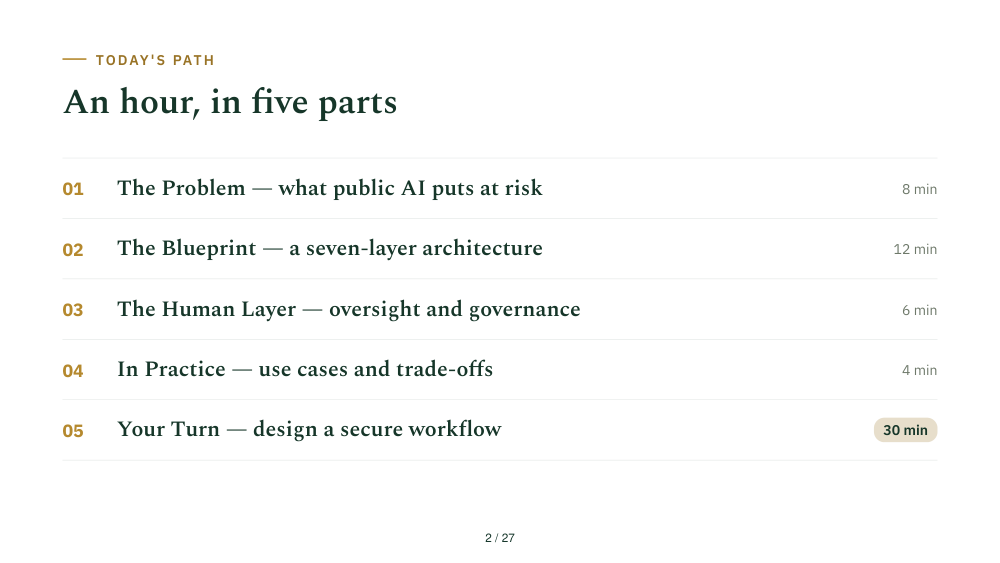
Here's the shape of our hour. We'll start with the problem — why public AI is a real risk for an institution like ours. Then the bulk of the time is the blueprint: a seven-layer architecture, and the human oversight that wraps around it. We'll look at where it pays off and what it honestly costs. And then the room takes over — thirty minutes where your group designs a secure workflow of your own. Keep that last part in mind; everything before it is ammunition for the activity.
Vocabulary
Term
Pronounce
Tiếng Việt
agenda
uh-JEN-duh
chương trình, nội dung buổi
roadmap
ROHD-map
lộ trình
the shape of our hour
bố cục của một tiếng đồng hồ
ammunition
am-yu-NI-shun
(ở đây) tư liệu/vũ khí cho phần sau
Diễn giải & cách nói (VN)
Giới thiệu lộ trình 5 phần. Đếm rõ 'one… two… three…'. Nhấn mạnh 'the room takes over' để báo trước phần hoạt động.
Luyện nói — ghi âm chính bạn
Bấm Record rồi đọc theo script.
Slide 03
AI in Classroom
Script — say this
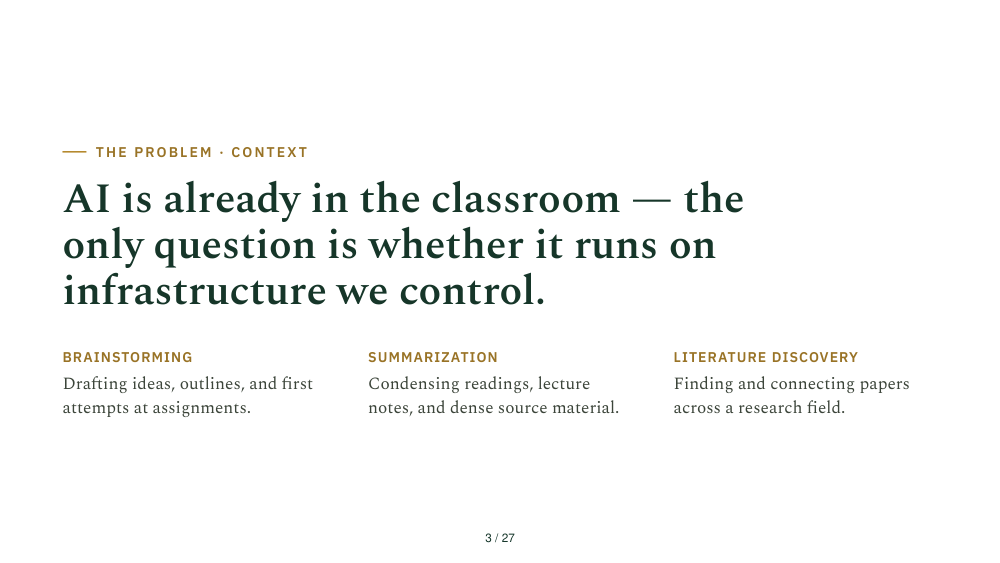
Let's be honest about where we are. This isn't a future problem. Our students are already using these tools every day — to brainstorm, to summarize readings, to find sources. Faculty are using them to draft feedback and prep material. The genie is out of the bottle. The question was never whether AI enters the institution. It's whether it enters through a door we control, or through a thousand browser tabs we can't see.
Vocabulary
Term
Pronounce
Tiếng Việt
already
awl-RE-di
đã, vốn dĩ
classroom
KLAS-room
lớp học
brainstorm
BRAYN-storm
động não, nghĩ ý tưởng
summarize
SUM-uh-raiz
tóm tắt
whether
WE-ther
liệu có… hay không
Diễn giải & cách nói (VN)
'AI is already in the classroom' — nhấn 'alREAdy'. Phân biệt 'whether' (WE-ther) với 'weather'. Giữ giọng thành thật, gần gũi ('Let's be honest').
Luyện nói — ghi âm chính bạn
Bấm Record rồi đọc theo script.
Slide 04
Risk of Public AI
Script — say this
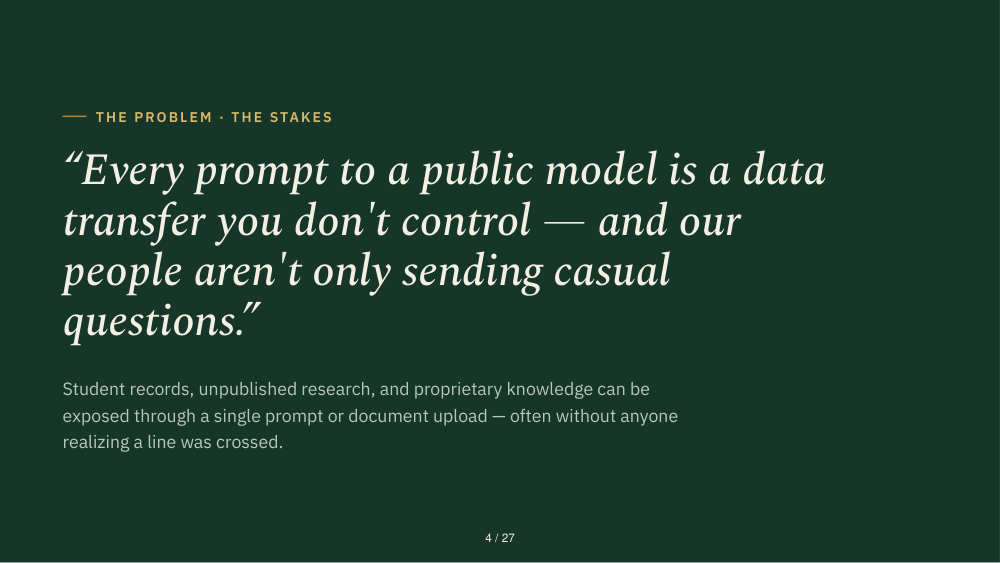
Here's the uncomfortable framing. Every time someone pastes text into a public chatbot, that's a data transfer — out of our walls, into a system we don't run, under terms we didn't write. For a casual question, fine. But our people aren't only asking casual questions. They're pasting in student records, draft manuscripts, exam content. Once it leaves, we've lost control of it, and we may have lost compliance with it too.
Vocabulary
Term
Pronounce
Tiếng Việt
prompt
prompt
câu lệnh/đoạn nhập gửi cho AI
data transfer
DAY-tuh TRANS-fer
sự chuyển giao dữ liệu
uncomfortable
un-KUMF-ter-bul
khó chịu, không thoải mái
paste
payst
dán (văn bản)
out of your control
ngoài tầm kiểm soát của bạn
Diễn giải & cách nói (VN)
Slide gây 'sốc nhẹ' — hạ giọng, nói chậm để tạo sức nặng. Nhấn 'a data transfer you DON'T conTROL'. Âm /p/ trong 'prompt', 'paste' bật rõ.
Luyện nói — ghi âm chính bạn
Bấm Record rồi đọc theo script.
Slide 05
Four Risks
Script — say this
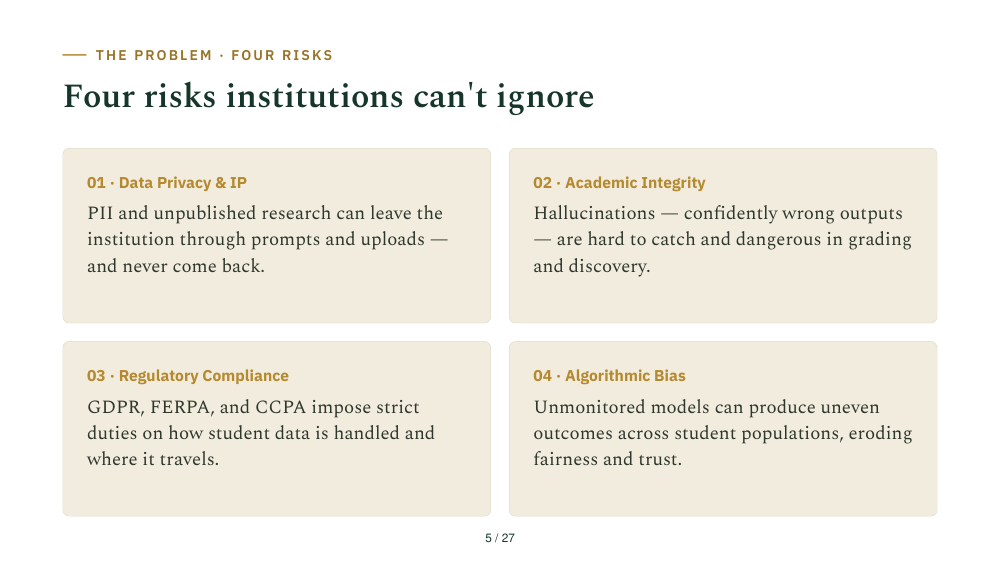
The risk isn't one thing — it's four, and they compound. First, data privacy and intellectual property: PII and unpublished work leaking out. Second, hallucinations: confidently wrong answers landing in grading or research. Third, regulation: GDPR, FERPA, and CCPA all have teeth, and a leak is a reportable event. Fourth, bias: models can quietly produce different outcomes across student groups. Any one of these is a headline. Together, they're the reason we're in this room.
Vocabulary
Term
Pronounce
Tiếng Việt
intellectual property (IP)
in-tel-EK-chu-al PRO-per-ti
sở hữu trí tuệ
compound
kom-POWND
(động từ) chồng chất, cộng dồn
compliance
kom-PLAI-ans
sự tuân thủ (quy định)
integrity
in-TEG-ri-ti
tính liêm chính, trung thực
bias
BAI-as
thiên kiến, định kiến
Diễn giải & cách nói (VN)
Liệt kê 4 rủi ro — đếm bằng tay. 'integrity', 'compliance', 'bias' là từ khó, tập riêng. 'they compound' = chúng cộng dồn (nhấn 'comPOUND').
Luyện nói — ghi âm chính bạn
Bấm Record rồi đọc theo script.
Slide 06
What Leaks
Script — say this
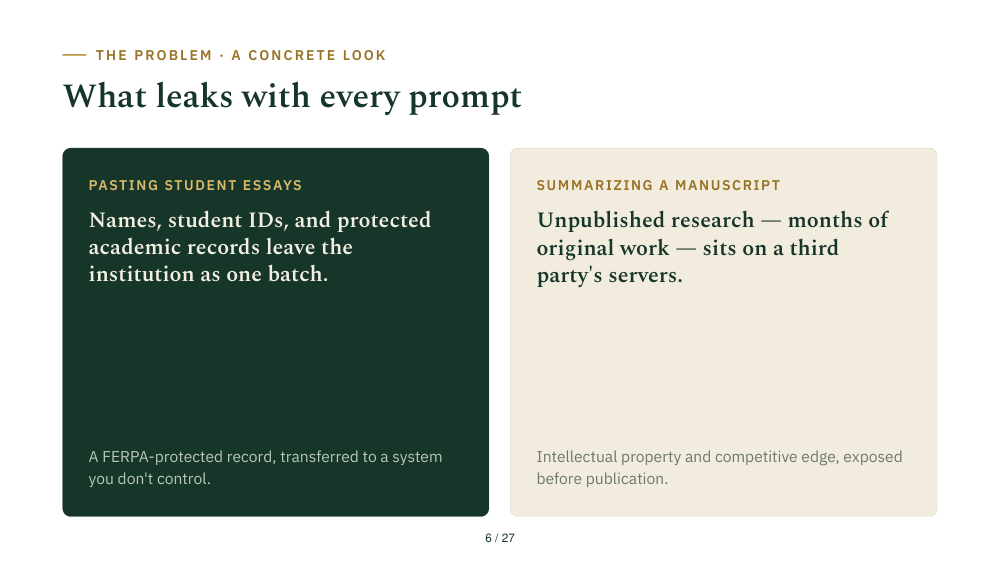
Let me make this concrete, because abstractions don't move budgets. Picture the grading side: a faculty member pastes a batch of student essays into a public tool to speed up feedback. That batch carries names, IDs, and protected academic records — straight out the door. Now the research side: a PhD student drops an unpublished manuscript in to get a summary. That's months of original work, your institution's competitive edge, sitting on a third party's servers. Same gesture, same convenience, two different kinds of irreversible exposure.
Vocabulary
Term
Pronounce
Tiếng Việt
concrete
KON-kreet
cụ thể
abstraction
ab-STRAK-shun
sự trừu tượng
budget
BUH-jet
ngân sách
essay
E-say
bài luận
leak
leek
rò rỉ
Diễn giải & cách nói (VN)
Kể một ví dụ cụ thể → giọng kể chuyện. 'abstractions don't move budgets' là câu đắt, nói dứt khoát. Phân biệt 'leak' (leek) với 'lick'.
Luyện nói — ghi âm chính bạn
Bấm Record rồi đọc theo script.
Slide 07
Part 2 · Blueprint
Script — say this
So that's the problem. Now the good news: this is a solvable architecture problem. For the next stretch I'll lay out a blueprint — a way to bring AI inside the walls, where every sensitive step happens on infrastructure we own. It's built as seven layers, and we'll go through them one at a time.
Vocabulary
Term
Pronounce
Tiếng Việt
solvable
SOL-vuh-bul
có thể giải quyết được
architecture
AR-ki-tek-cher
kiến trúc
infrastructure
IN-fruh-struk-cher
hạ tầng
inside the walls
bên trong (tường rào) tổ chức
layer
LAY-er
tầng, lớp
Diễn giải & cách nói (VN)
Chuyển sang phần giải pháp → giọng lạc quan hơn ('the good news'). 'architecture' và 'infrastructure' tập kỹ: cả hai kết thúc '-cher'.
Luyện nói — ghi âm chính bạn
Bấm Record rồi đọc theo script.
Slide 08
Five Principles
Script — say this
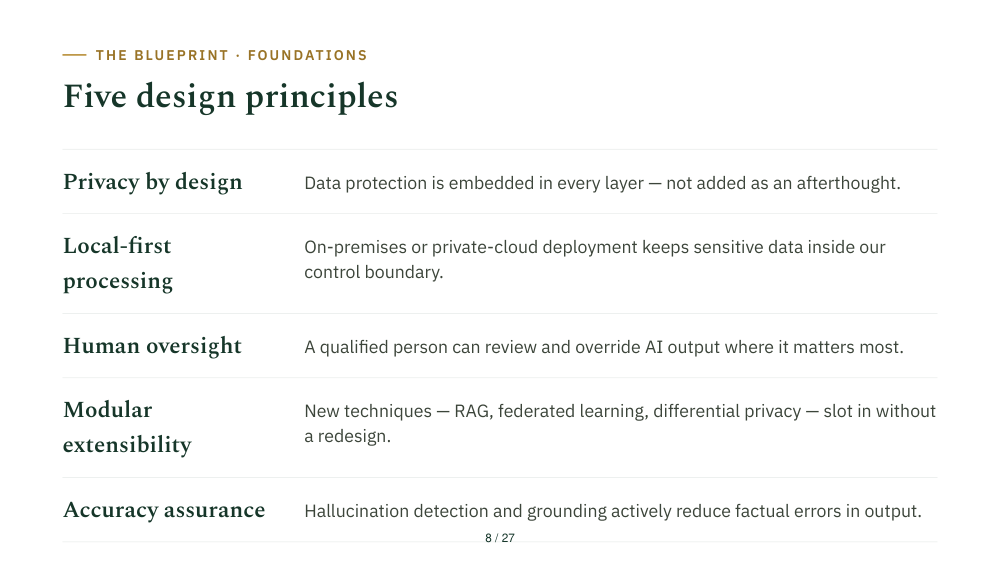
Before the diagram, the five ideas underneath it. Privacy by design means security is baked into every layer, not bolted on at the end. Local-first means sensitive data stays inside our boundary. Human oversight means a person can always step in. Modular means we can add new techniques later without a rebuild. And accuracy assurance means we actively fight hallucinations rather than hoping they don't happen. Hold these five; every design choice that follows traces back to one of them.
Vocabulary
Term
Pronounce
Tiếng Việt
privacy by design
PRAI-vuh-si bai di-ZAIN
bảo mật ngay từ thiết kế
baked in
baykt in
tích hợp sẵn (không phải gắn thêm)
bolted on
BOHL-ted on
lắp ghép thêm vào sau
oversight
OH-ver-sait
sự giám sát
modular
MO-ju-lar
dạng mô-đun, lắp ghép
Diễn giải & cách nói (VN)
5 nguyên tắc — nói nhịp đều, mỗi nguyên tắc một hơi. Cặp đối lập 'baked in' ↔ 'bolted on' nhấn để người nghe nhớ. 'privacy' đọc PRAI-vuh-si (không 'pri-').
Luyện nói — ghi âm chính bạn
Bấm Record rồi đọc theo script.
Slide 09
7-Layer Architecture
Script — say this
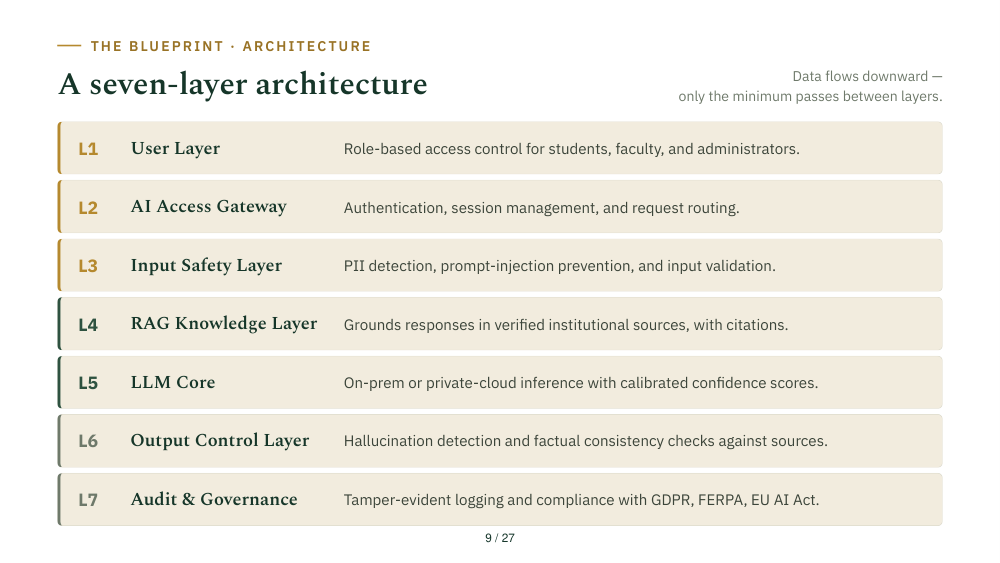
This is the heart of the talk. Seven layers, and data flows top to bottom. Each layer does one job, and — this is the key idea — it only passes forward the minimum the next layer needs. A request comes in at the user layer, gets authenticated at the gateway, scrubbed of PII at input safety, grounded in our own sources at the RAG layer, run through our own model at the core, fact-checked at output control, and logged for accountability at the audit layer. Seven distinct concerns, seven places to test independently. We'll take them in three groups next.
Vocabulary
Term
Pronounce
Tiếng Việt
seven-layer
SE-ven LAY-er
bảy tầng
authenticate
aw-THEN-ti-kayt
xác thực
gateway
GAYT-way
cổng (truy cập)
scrub / scrubbed
skrub
làm sạch (loại bỏ dữ liệu nhạy cảm)
accountability
uh-kown-tuh-BI-li-ti
tính chịu trách nhiệm
Diễn giải & cách nói (VN)
Slide trung tâm — nói chậm, để khán giả nhìn sơ đồ. Liệt kê hành trình 'authenticated… scrubbed… grounded… logged'. 'authenticate' tập kỹ (4 âm tiết).
Luyện nói — ghi âm chính bạn
Bấm Record rồi đọc theo script.
Slide 10
Layers 1–3
Script — say this
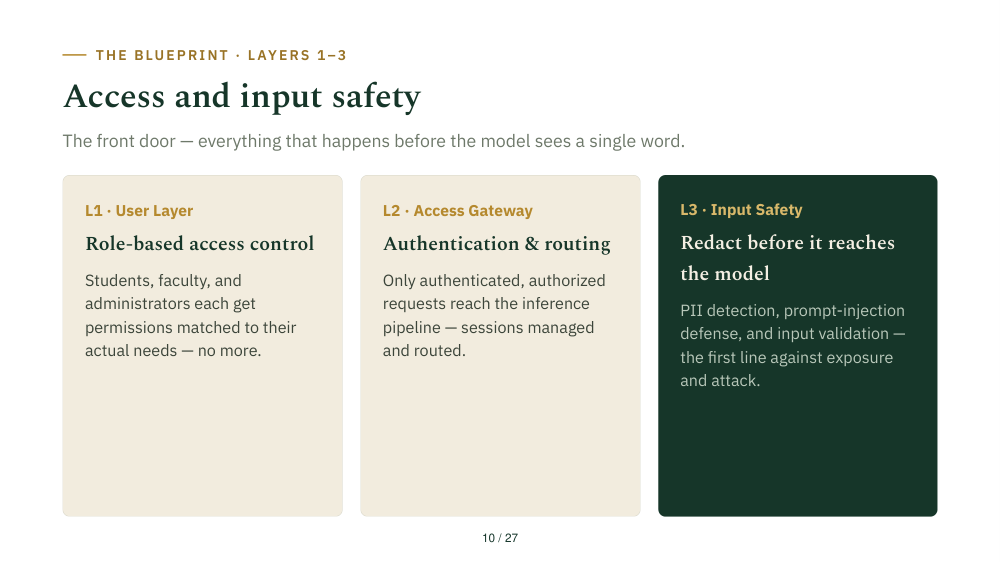
The first three layers are the front door, and they're all about defense before the model ever sees anything. Layer one decides who's even allowed in, and what they can do once they are. Layer two handles the plumbing — authentication and routing. Layer three is the one I'd circle in red: it strips out personal information and blocks prompt-injection attempts before the text reaches the model. That's where a leaked student ID gets caught and redacted automatically.
Vocabulary
Term
Pronounce
Tiếng Việt
front door
frunt dor
cửa trước (lớp phòng vệ đầu tiên)
role-based access
rohl-bayst AK-ses
truy cập theo vai trò
redact
ri-DAKT
che/xoá thông tin nhạy cảm
prompt injection
prompt in-JEK-shun
tấn công chèn lệnh độc hại
circle in red
khoanh đỏ (nhấn mạnh là quan trọng)
Diễn giải & cách nói (VN)
'the one I'd circle in red' = lớp tôi nhấn mạnh nhất. 'redact' (ri-DAKT) và 'injection' tập kỹ. Âm cuối /kt/ trong 'redact' đừng nuốt.
Luyện nói — ghi âm chính bạn
Bấm Record rồi đọc theo script.
Slide 11
Layers 4–5
Script — say this
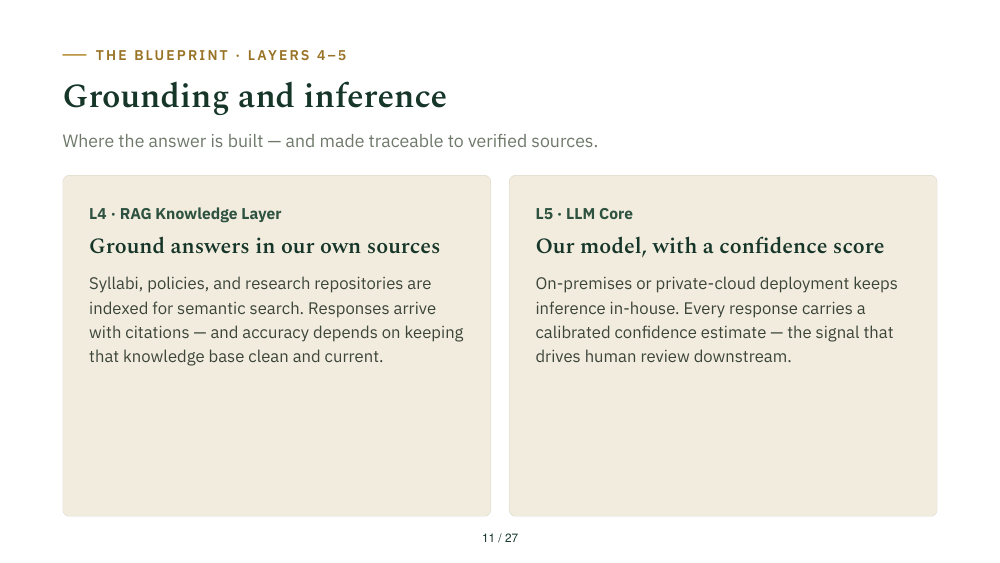
The middle two layers are where the answer actually gets built — and where we make it trustworthy. Layer four is retrieval-augmented generation: instead of letting the model free-associate, we ground it in our own verified sources — syllabi, policies, research repositories — and it cites them. Layer five is the model itself, running on our hardware, and crucially it doesn't just give an answer, it gives a confidence score alongside it. That score is what powers the human review we'll talk about later.
Vocabulary
Term
Pronounce
Tiếng Việt
retrieval-augmented generation (RAG)
ri-TREE-val awg-MEN-ted
sinh nội dung tăng cường truy hồi
ground / grounded
grownd
neo/đặt nền câu trả lời vào nguồn
syllabus / syllabi
SI-luh-bus / SI-luh-bai
đề cương môn học (số nhiều: syllabi)
cite
sait
trích dẫn nguồn
confidence score
KON-fi-dens skor
điểm độ tin cậy
Diễn giải & cách nói (VN)
RAG đọc là /ræg/ (một âm). 'syllabi' số nhiều đọc 'SI-luh-bai'. Nhấn 'it CItes them' để làm rõ điểm mạnh: có trích dẫn.
Luyện nói — ghi âm chính bạn
Bấm Record rồi đọc theo script.
Slide 12
Layers 6–7
Script — say this
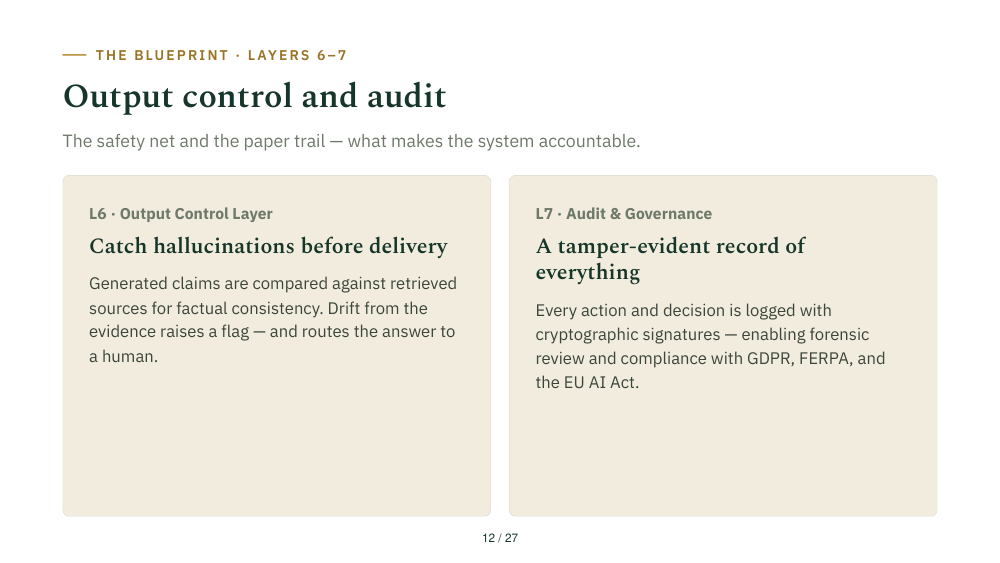
The last two layers are the safety net and the paper trail. Layer six checks the model's answer against the sources it was supposed to use — if the answer drifts from the evidence, that's a hallucination flag. Layer seven logs everything, with tamper-evident signatures, so that months later we can prove who did what and show a regulator we were compliant. Together these turn AI from a black box into something we can actually audit.
Vocabulary
Term
Pronounce
Tiếng Việt
safety net
SAYF-ti net
lưới an toàn
paper trail
PAY-per trayl
dấu vết hồ sơ (để truy vết)
drift
drift
trôi/lệch khỏi (nguồn)
tamper-evident
TAM-per E-vi-dent
có dấu hiệu nếu bị can thiệp
black box
blak boks
hộp đen (không nhìn thấy bên trong)
Diễn giải & cách nói (VN)
Cặp ẩn dụ 'safety net' và 'paper trail' nói rõ ràng. 'tamper-evident' là từ khó — tách 'TAM-per' + 'E-vi-dent'. Kết: 'from a black box into something we can AUdit'.
Luyện nói — ghi âm chính bạn
Bấm Record rồi đọc theo script.
Slide 13
Workflow
Script — say this
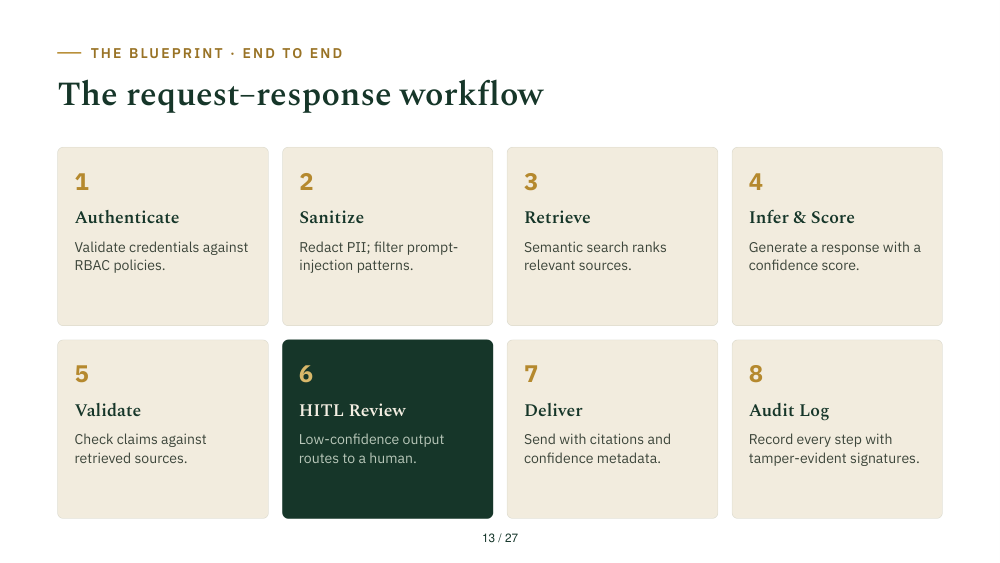
Here's the whole thing in motion — one request, eight steps. Authenticate the user, sanitize their input, retrieve relevant sources, run inference with a confidence score, validate the output against those sources, and then — only if confidence is low — pause for a human to review. Once it's cleared, deliver the answer with its citations, and log the entire transaction. Notice that the human only enters when the system is unsure. That's deliberate, and it's what keeps this practical at scale.
Vocabulary
Term
Pronounce
Tiếng Việt
workflow
WERK-floh
luồng công việc/quy trình
sanitize
SA-ni-taiz
làm sạch (đầu vào)
retrieve
ri-TREEV
truy hồi, lấy về
validate
VA-li-dayt
kiểm chứng, xác nhận
at scale
at skayl
ở quy mô lớn
Diễn giải & cách nói (VN)
Đọc 8 bước như đếm nhịp, mỗi bước một động từ mạnh. 'the human only enters when the system is unSURE' — nhấn 'unsure'. 'at scale' = ở quy mô lớn, cụm hay dùng.
Luyện nói — ghi âm chính bạn
Bấm Record rồi đọc theo script.
Slide 14
Privacy Toolkit
Script — say this
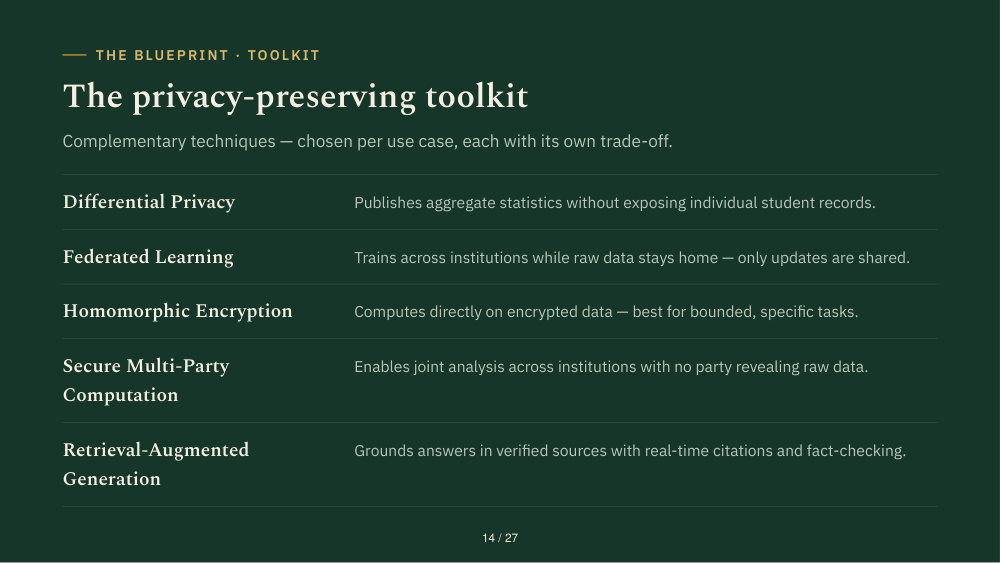
The architecture also has room for a toolkit of privacy techniques — and I want to be honest that these are trade-offs, not magic. Differential privacy lets us publish statistics without exposing individuals, but turn the dial too far and the numbers get noisy. Federated learning lets institutions train together without sharing raw data. Homomorphic encryption and secure multi-party computation let us compute on data we never decrypt — powerful, but still expensive. And RAG, which we've already met, grounds answers in verified knowledge. You don't need all five on day one; you pick what fits the use case.
Vocabulary
Term
Pronounce
Tiếng Việt
differential privacy
di-fer-EN-shul PRAI-vuh-si
quyền riêng tư vi phân
federated learning
FE-der-ay-ted LER-ning
học liên kết (không gom dữ liệu)
homomorphic encryption
ho-mo-MOR-fik en-KRIP-shun
mã hoá đồng cấu
trade-off
TRAYD-of
sự đánh đổi
noisy
NOY-zi
nhiễu (số liệu kém chính xác)
Diễn giải & cách nói (VN)
Nhiều thuật ngữ khó — đây là slide nên TẬP NHIỀU NHẤT. Đọc chậm từng cụm. 'homomorphic' chia nhỏ: ho-mo-MOR-fik. Thành thật: 'trade-offs, not magic'.
Luyện nói — ghi âm chính bạn
Bấm Record rồi đọc theo script.
Slide 15
Part 3 · Human Loop
Script — say this
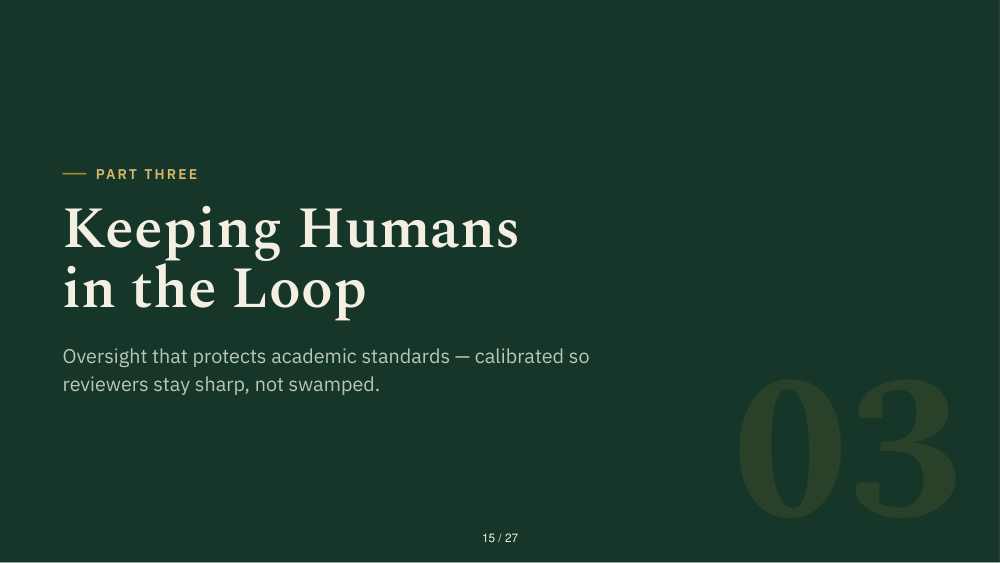
The architecture is only half the story. The other half is the people. No matter how good the model gets, there are decisions a university should never fully automate — grades, research integrity, anything touching a student's record. So this next part is about how we keep a human in the loop without drowning them in alerts.
Vocabulary
Term
Pronounce
Tiếng Việt
in the loop
in thuh loop
có con người tham gia/giám sát
automate
AW-tuh-mayt
tự động hoá
integrity
in-TEG-ri-ti
tính liêm chính
drown / drowning
drown
nhấn chìm (quá tải)
alert
uh-LERT
cảnh báo
Diễn giải & cách nói (VN)
Chuyển sang 'phần con người' → giọng ấm, nhân văn. 'decisions a university should NEVER fully autoMATE' — nhấn 'never'. 'drowning them in alerts' = làm họ ngộp trong cảnh báo.
Luyện nói — ghi âm chính bạn
Bấm Record rồi đọc theo script.
Slide 16
70% Threshold
Script — say this
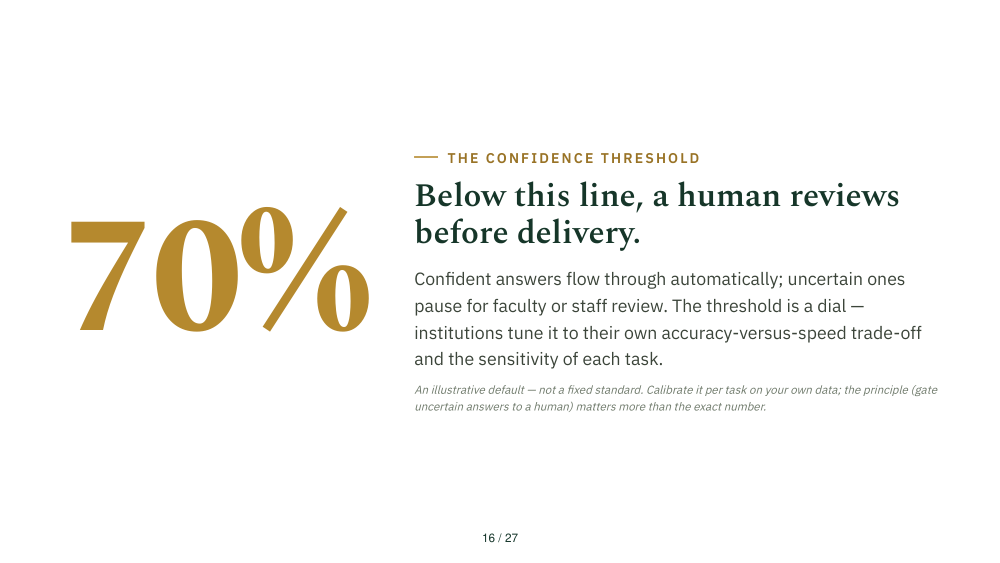
Here's the mechanism that makes human oversight workable. We set a confidence threshold — in our framework, seventy percent. Above it, the system delivers automatically. Below it, the answer doesn't go anywhere until a qualified person signs off. This is the dial that balances speed against safety, and every institution should tune it to their own appetite for risk. Set it higher for grading, lower for low-stakes questions. The number isn't sacred — the principle is.
Vocabulary
Term
Pronounce
Tiếng Việt
threshold
THRESH-hohld
ngưỡng
confidence
KON-fi-dens
độ tin cậy
sign off
sain of
phê duyệt, ký duyệt
appetite for risk
A-pe-tait for risk
khẩu vị rủi ro
the number isn't sacred
SAY-kred
con số không phải bất biến
Diễn giải & cách nói (VN)
'threshold' có /th/ đầu (đặt lưỡi giữa răng) — TẬP KỸ. Câu chốt mạnh: 'The number isn't SAcred — the PRINciple is.' Dừng trước nó 1 nhịp.
Luyện nói — ghi âm chính bạn
Bấm Record rồi đọc theo script.
Slide 17
Human Oversight
Script — say this
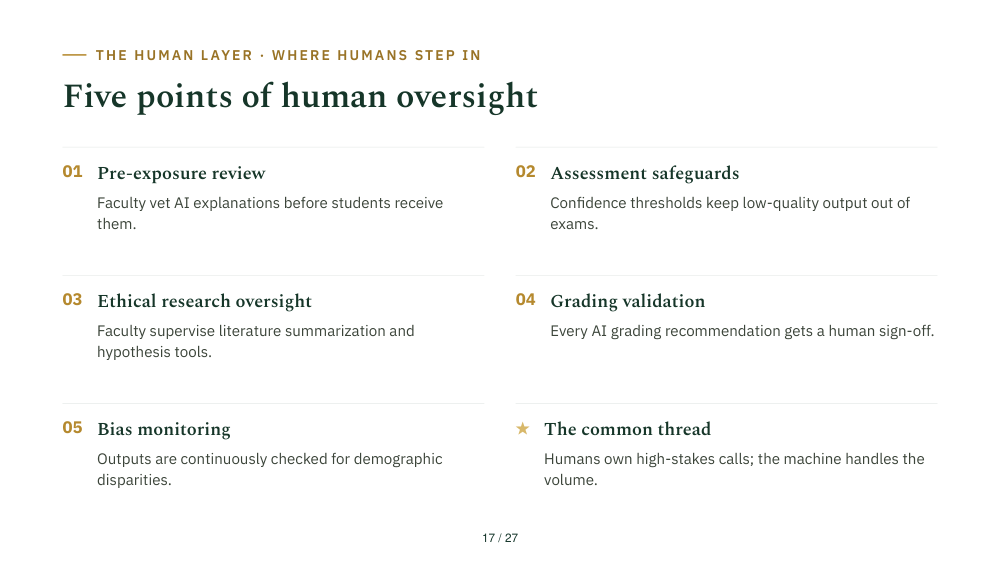
Where exactly does the human step in? Five places. Faculty review AI explanations before students ever see them. Confidence thresholds keep low-quality output out of exams and grading. Researchers get faculty supervision on literature work. Grading recommendations always get a human sign-off before scores are final. And someone is continuously watching for bias across student groups. The thread through all five: humans own the high-stakes calls, the machine handles the volume.
Vocabulary
Term
Pronounce
Tiếng Việt
pre-exposure review
pre-ik-SPOH-zher
rà soát trước khi đưa ra
vet
vet
thẩm định, kiểm duyệt
supervision
su-per-VI-zhun
sự giám sát
high-stakes
HAI-stayks
mức rủi ro cao, hệ trọng
volume
VOL-yum
khối lượng (công việc lớn)
Diễn giải & cách nói (VN)
Liệt kê 5 điểm — đếm rõ. Câu chốt đối xứng: 'humans own the HIGH-stakes calls, the machine handles the VOLume.' Nhấn 2 vế đối nhau.
Luyện nói — ghi âm chính bạn
Bấm Record rồi đọc theo script.
Slide 18
Reviewer Fatigue
Script — say this
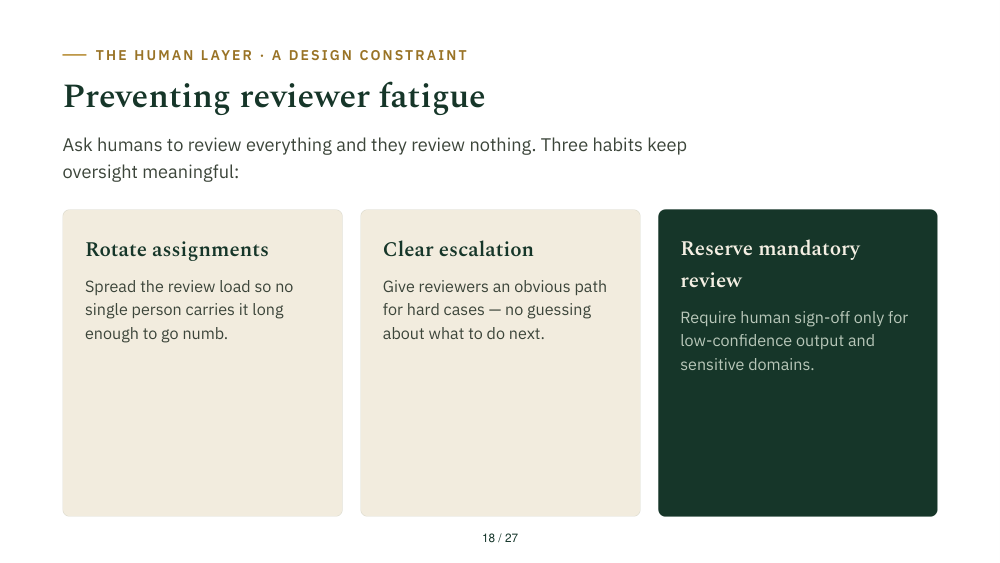
There's a failure mode we have to design against: alert fatigue. If you ask a human to review everything, they stop really reviewing anything — they just click approve. So we're deliberate about it. We rotate review assignments so no one burns out. We give clear escalation paths for the hard cases. And we reserve mandatory review for what actually warrants it — low-confidence answers and sensitive domains like assessment and student records. Routine, low-risk questions get lighter oversight. Protect the reviewer's attention and you protect the whole system.
Vocabulary
Term
Pronounce
Tiếng Việt
fatigue
fuh-TEEG
sự mệt mỏi, kiệt sức
failure mode
FAYL-yer mohd
kiểu/cách hệ thống hỏng
rotate
ROH-tayt
luân phiên
escalation
es-kuh-LAY-shun
đường leo thang/chuyển cấp
warrant
WOR-ant
xứng đáng, đáng để
Diễn giải & cách nói (VN)
'fatigue' đọc 'fuh-TEEG' (g câm cuối nhẹ) — dễ sai. 'review everything → review nothing' là câu đối, nhấn 'everything' và 'nothing'.
Luyện nói — ghi âm chính bạn
Bấm Record rồi đọc theo script.
Slide 19
Governance
Script — say this
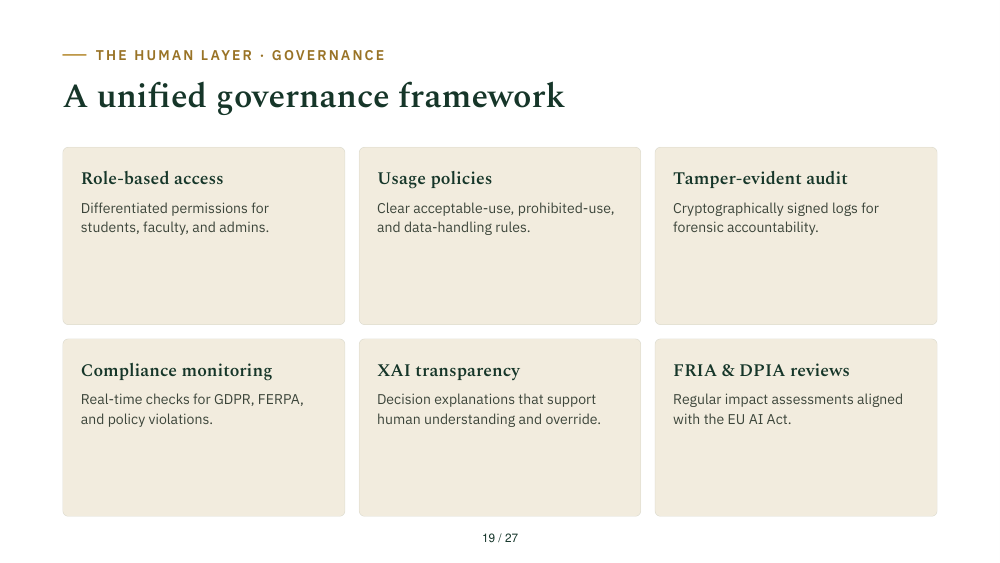
Wrapping all of this is governance — the set of controls that turns a clever system into an accountable one. Access control defines who can do what. Usage policies define acceptable use. Tamper-evident logs give us forensic proof. Automated monitoring watches for compliance violations in real time. Explainability lets a human understand and override a decision. And regular impact assessments keep us aligned with regulations like the EU AI Act. This is the layer the auditors and the lawyers will care about most.
Vocabulary
Term
Pronounce
Tiếng Việt
governance
GUH-ver-nans
quản trị (khung kiểm soát)
accountable
uh-KOWN-tuh-bul
có trách nhiệm giải trình
forensic
fuh-REN-zik
pháp y, phục vụ điều tra
explainability
ik-splay-nuh-BI-li-ti
khả năng giải thích
EU AI Act
Đạo luật AI của EU
Diễn giải & cách nói (VN)
'governance' (GUH-ver-nans) đọc nhanh, đừng tách 'govern-ance'. Câu chốt: 'the layer the auditors and the lawyers will care about most.'
Luyện nói — ghi âm chính bạn
Bấm Record rồi đọc theo script.
Slide 20
Use Cases
Script — say this
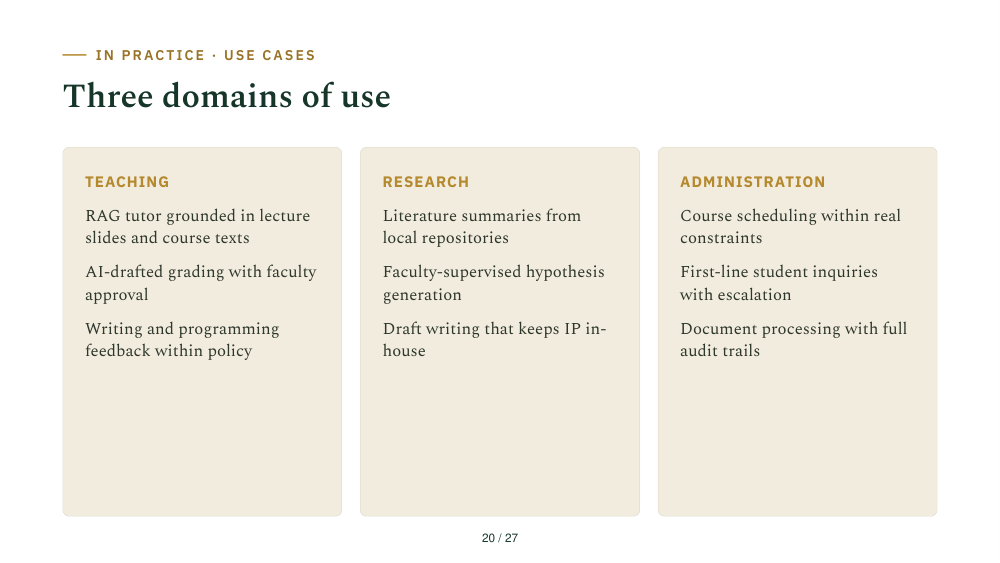
So what does this actually buy us? Three domains. In teaching: a tutor that pulls from our own lecture slides, and AI-drafted grading that a faculty member approves. In research: literature summaries and hypothesis support that never expose unpublished work. In administration: scheduling, first-line student inquiries, document processing — all with audit trails. The pattern is the same everywhere — the AI accelerates the work, a human owns the judgment, and the data never leaves.
Vocabulary
Term
Pronounce
Tiếng Việt
tutor
TYU-ter
gia sư, trợ giảng
hypothesis
hai-PO-the-sis
giả thuyết
scheduling
SKE-ju-ling
lập lịch
inquiry / inquiries
IN-kwuh-ri
câu hỏi/yêu cầu
accelerate
ak-SE-luh-rayt
tăng tốc
Diễn giải & cách nói (VN)
3 lĩnh vực: teaching / research / administration — đọc rõ ranh giới. Câu khuôn mẫu đẹp: 'the AI accelerates the work, a human owns the judgment, and the data never leaves.' Học thuộc câu này.
Luyện nói — ghi âm chính bạn
Bấm Record rồi đọc theo script.
Slide 21
Benefits & Trade-offs
Script — say this
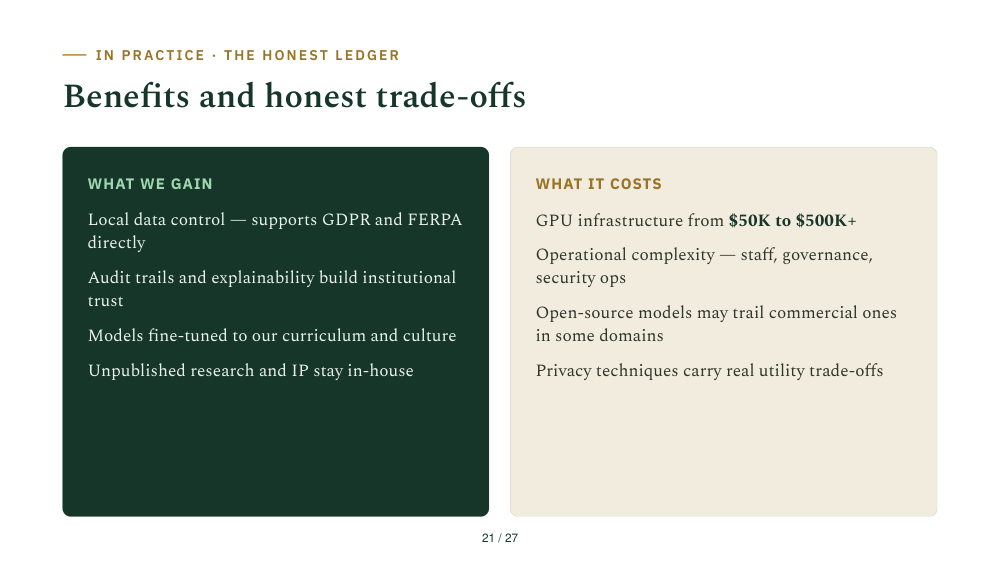
Now let me be straight with you, because you're the people who sign off on this. The benefits are real: data stays under our control, we get audit trails and trust, we can fine-tune on our own curriculum, and our IP stays ours. But it isn't free. Serious hardware runs anywhere from fifty thousand to half a million dollars or more. It takes staff to run, governance to maintain, and open-source models may still trail the big commercial ones in specialized domains. This is a genuine investment decision — I'm not going to pretend otherwise.
Vocabulary
Term
Pronounce
Tiếng Việt
trade-off
TRAYD-of
sự đánh đổi
the honest ledger
LE-jer
bảng cân đối trung thực (được/mất)
fine-tune
FAIN-tyun
tinh chỉnh (mô hình)
hardware
HARD-wair
phần cứng
investment decision
in-VEST-ment
quyết định đầu tư
Diễn giải & cách nói (VN)
Giọng thẳng thắn, người lớn nói với người ra quyết định. Đọc số tiền rõ: 'fifty thousand to half a million dollars'. 'I'm not going to pretend otherwise' — chốt chắc nịch.
Luyện nói — ghi âm chính bạn
Bấm Record rồi đọc theo script.
Slide 22
Part 5 · Activity
Script — say this
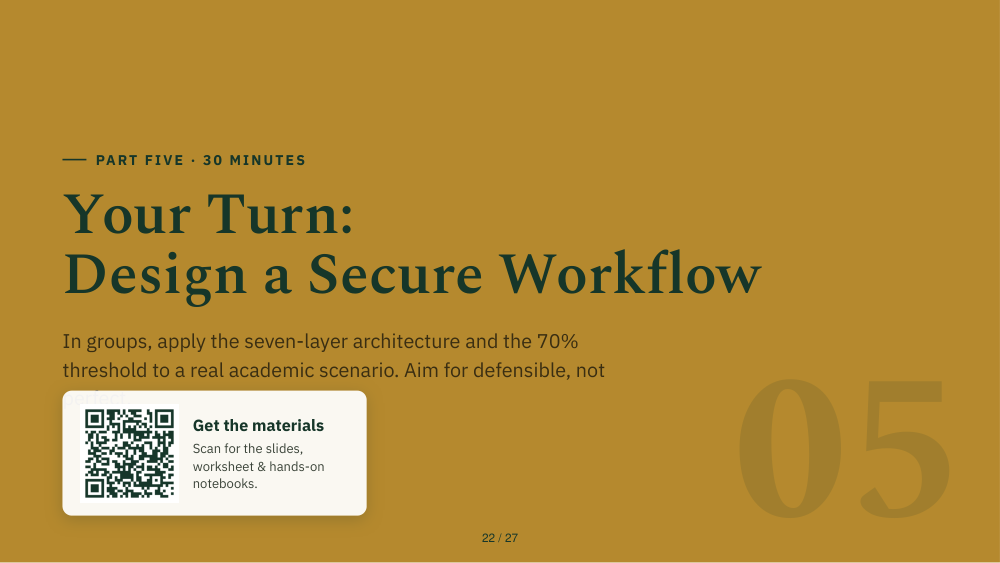
Alright — this is where you take over. For the next thirty minutes, your group is the design team. You'll pick a scenario, walk it through the architecture we just covered, and design the human checkpoints yourselves. Don't aim for perfect; aim for defensible. Worksheets are on your tables. Find your group, and let's get into it.
Vocabulary
Term
Pronounce
Tiếng Việt
your turn
yor tern
đến lượt bạn
design team
di-ZAIN teem
nhóm thiết kế
checkpoint
CHEK-point
điểm kiểm soát
defensible
di-FEN-si-bul
có thể bảo vệ/biện hộ được
aim for
aym for
hướng tới, đặt mục tiêu
Diễn giải & cách nói (VN)
Chuyển sang hoạt động → giọng phấn khích, mời gọi. Câu khẩu hiệu: 'Don't aim for PERfect; aim for deFENsible.' Nhấn 2 tính từ.
Luyện nói — ghi âm chính bạn
Bấm Record rồi đọc theo script.
Slide 23
Choose Scenario
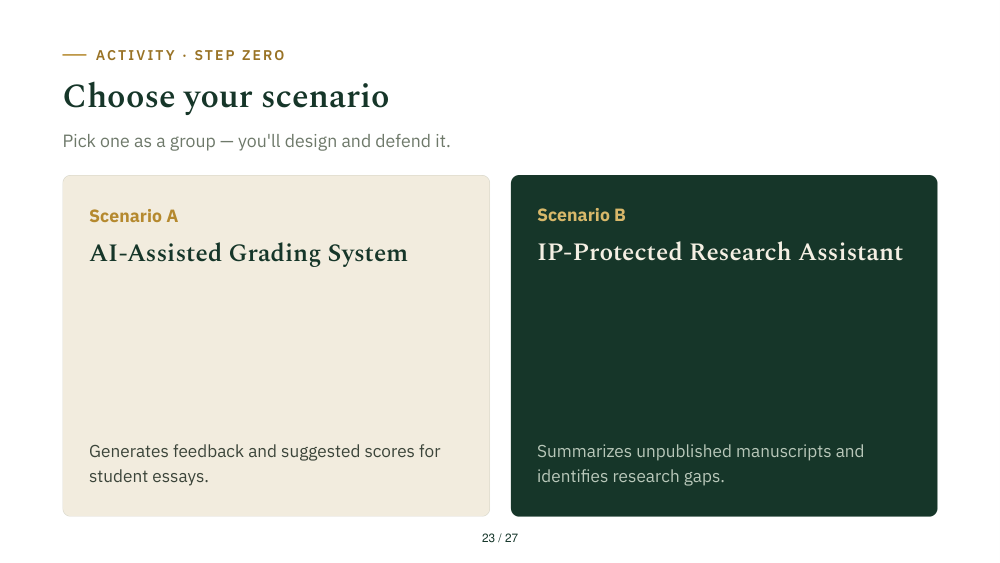
Script — say this
First decision: pick one scenario as a group. Scenario A is an AI-assisted grading system — it drafts feedback and suggested scores for student essays. Scenario B is an IP-protected research assistant — it summarizes unpublished manuscripts and finds research gaps. Both are real, both are risky in interesting ways. Pick the one closest to your own work, because you'll be defending your design at the end.
Vocabulary
Term
Pronounce
Tiếng Việt
scenario
si-NAH-ri-oh
kịch bản, tình huống
draft
draft
soạn nháp
manuscript
MAN-yu-skript
bản thảo
research gap
RI-serch gap
khoảng trống nghiên cứu
defend
di-FEND
bảo vệ (phương án)
Diễn giải & cách nói (VN)
'scenario' đọc si-NAH-ri-oh (không 'sce-nay-rio'). Phân biệt rõ A và B. 'you'll be deFENding your design at the end' — báo trước.
Luyện nói — ghi âm chính bạn
Bấm Record rồi đọc theo script.
Slide 24
Steps 1–2
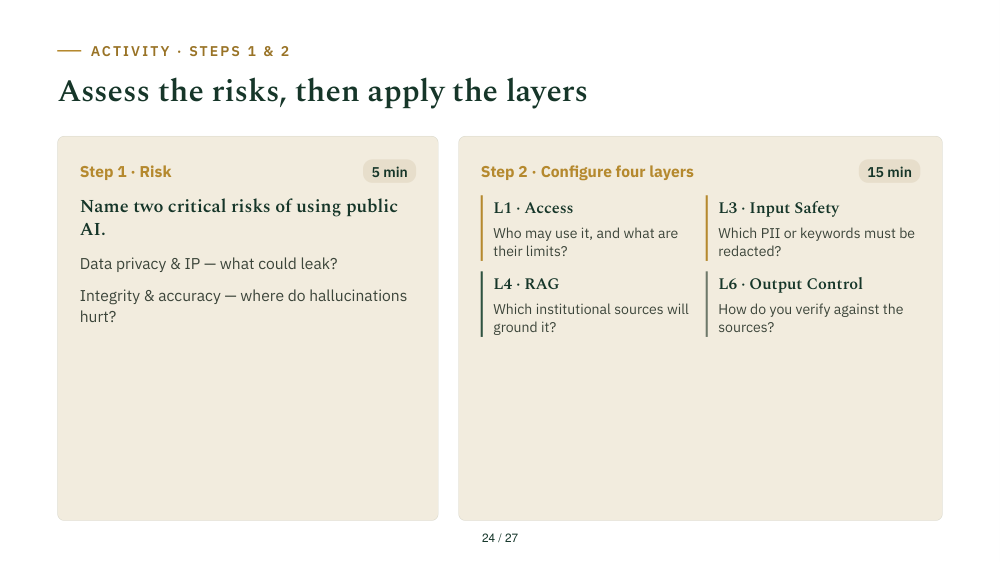
Script — say this
The first twenty minutes break into two parts. Spend five minutes on risk: name at least two real dangers of doing your scenario on public ChatGPT instead of an internal system — think data and IP exposure, think hallucinations landing in a grade or a literature review. Then fifteen minutes applying the architecture: configure four specific layers. Who can use it. What PII gets redacted. Which of our sources ground it. And how you verify the answer against those sources. Be concrete — names of real systems, real data sources.
Vocabulary
Term
Pronounce
Tiếng Việt
assess
uh-SES
đánh giá
configure
kun-FI-gyer
cấu hình
exposure
ik-SPOH-zher
sự phơi lộ (dữ liệu)
be concrete
bi KON-kreet
hãy cụ thể
source
sors
nguồn (dữ liệu)
Diễn giải & cách nói (VN)
Hướng dẫn theo thời gian: '5 minutes… then 15 minutes'. 'configure four specific layers' — nhấn 'four'. 'be concrete' lặp lại để học viên nhớ.
Luyện nói — ghi âm chính bạn
Bấm Record rồi đọc theo script.
Slide 25
Step 3
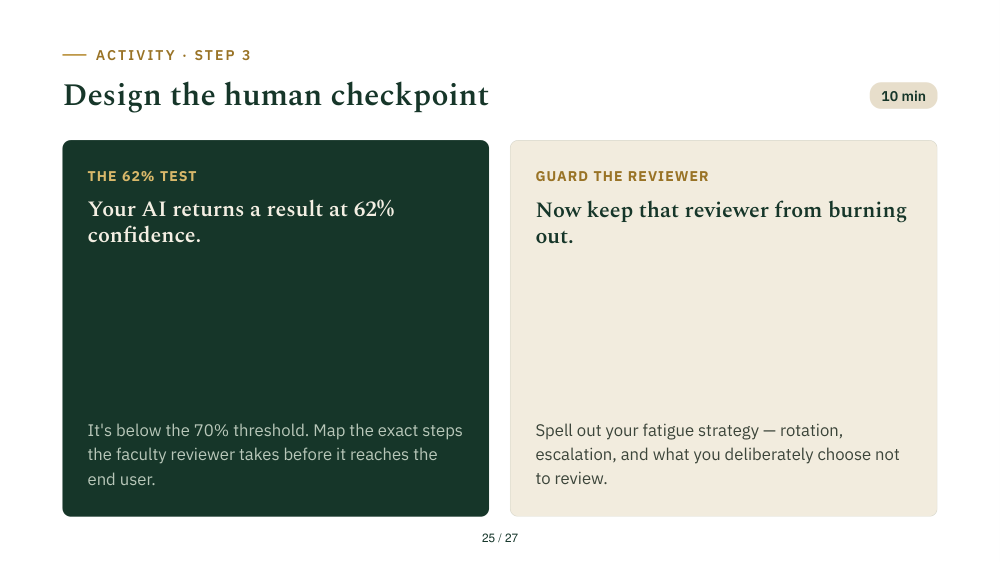
Script — say this
The last ten minutes of design are about the human checkpoint — the part most teams get wrong. Here's a specific test: your AI produces a result at sixty-two percent confidence. That's below the threshold. Walk through exactly what the faculty reviewer does before that result reaches anyone. And then the harder question — how do you keep that reviewer from burning out? Don't just say more review; tell me your rotation, your escalation, what you choose not to review. That's the difference between a design that works on a slide and one that works on a Tuesday.
Vocabulary
Term
Pronounce
Tiếng Việt
human checkpoint
HYU-man CHEK-point
chốt kiểm soát của con người
confidence
KON-fi-dens
độ tin cậy
burn out
bern owt
kiệt sức
rotation
roh-TAY-shun
luân phiên
on a Tuesday
(ẩn dụ) trong thực tế hằng ngày
Diễn giải & cách nói (VN)
Đọc số '62%' = 'sixty-two percent'. Câu kết hay: 'a design that works on a SLIDE and one that works on a TUESday.' Nhấn 'slide' ↔ 'Tuesday'.
Luyện nói — ghi âm chính bạn
Bấm Record rồi đọc theo script.
Slide 26
Rubric
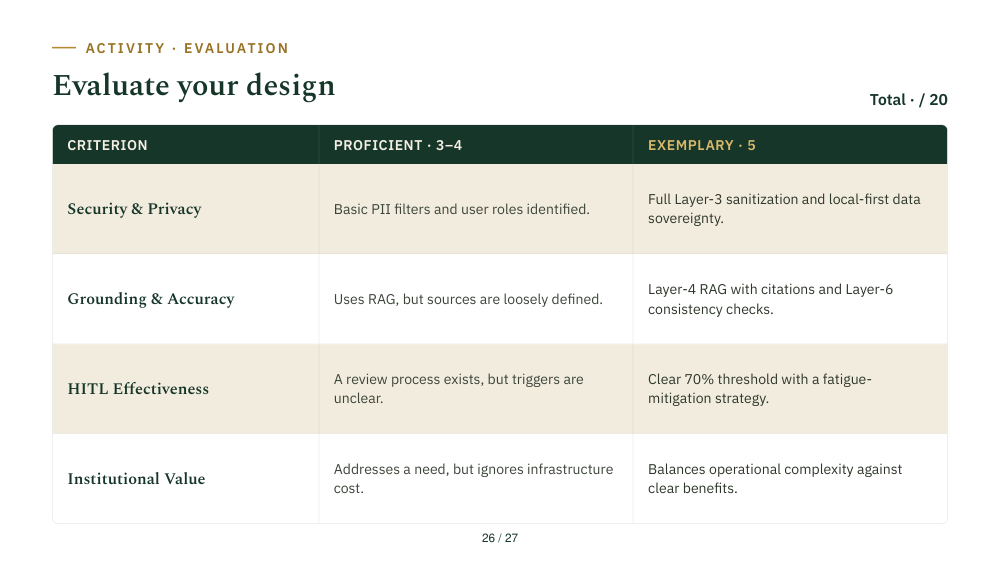
Script — say this
When you present, you'll be scored on four things, out of twenty. Security and privacy — did you really handle PII and access, or wave at it? Grounding and accuracy — are you using RAG with real sources and consistency checks? HITL effectiveness — is your human review thoughtful, or did you either automate everything or bury your reviewers? And institutional value — does this actually solve a real need, with eyes open about the cost? Use these as a checklist while you design, not just at the end.
Vocabulary
Term
Pronounce
Tiếng Việt
rubric
ROO-brik
khung chấm điểm, tiêu chí
criterion / criteria
krai-TI-ri-on
tiêu chí (số nhiều: criteria)
proficient
pruh-FI-shent
thành thạo, đạt
exemplary
ig-ZEM-pluh-ri
xuất sắc, mẫu mực
wave at it
làm qua loa, chỉ 'phẩy tay' cho có
Diễn giải & cách nói (VN)
4 tiêu chí, /20 điểm. 'rubric' (ROO-brik) và 'exemplary' (ig-ZEM-pluh-ri) tập kỹ. Giọng đặt câu hỏi gợi mở: 'did you really… or wave at it?'
Luyện nói — ghi âm chính bạn
Bấm Record rồi đọc theo script.
Slide 27
Thank You
Script — say this
Thank you. To bring it home: the goal isn't to lock AI out of the university — it's to bring it inside, where we control the data, ground the answers, and keep a human on the high-stakes calls. The framework is a starting point, not a finished product; the real test is the pilot. I'd love to hear what your groups designed — let's open it up for discussion.
Vocabulary
Term
Pronounce
Tiếng Việt
bring it home
chốt lại, đúc kết
lock out
lok owt
khoá/chặn bên ngoài
high-stakes calls
HAI-stayks kolz
các quyết định hệ trọng
pilot
PAI-lut
thử nghiệm/triển khai thí điểm
open it up
mở ra (cho thảo luận)
Diễn giải & cách nói (VN)
Câu kết toàn bài — nói chậm, ấm, biết ơn. Khẩu hiệu chốt: 'bring AI INside the walls — conTROLLED, GROUNDed, and human-superVISED.' Cảm ơn rồi mời thảo luận với nụ cười.
Luyện nói — ghi âm chính bạn
Bấm Record rồi đọc theo script.
Câu & cụm từ thông dụng khi dẫn workshop
Những câu chức năng giúp bạn mở đầu, chuyển ý, điều phối hoạt động, xử lý câu hỏi
và kết thúc tự nhiên hơn. Nghe audio mỗi nhóm, chọn 2–3 câu bạn thấy hợp và học thuộc.
Opening & welcome
Good morning, everyone — thank you all for being here.
Chào buổi sáng, cảm ơn mọi người đã đến.
Can everyone hear me at the back?
Phía cuối phòng nghe rõ không ạ?
Let me quickly introduce myself.
Tôi xin giới thiệu nhanh về mình.
Before we start, let me give you a quick overview.
Trước khi bắt đầu, tôi sẽ giới thiệu nhanh tổng quan.
Feel free to stop me at any point if something isn't clear.
The session has two parts: a talk, then a hands-on activity.
Buổi học gồm hai phần: phần trình bày, rồi phần thực hành.
Let's start with the problem, and then move to the solution.
Ta bắt đầu từ vấn đề, rồi chuyển sang giải pháp.
Keep this in mind — we'll come back to it later.
Hãy ghi nhớ điều này — lát nữa ta sẽ quay lại.
Transitions between sections
So, that covers the first part. Let's move on.
Vậy là xong phần một. Ta chuyển tiếp nhé.
With that in mind, let's look at the architecture.
Với ý đó, ta cùng xem kiến trúc.
This brings us to the next point.
Điều này dẫn ta đến ý tiếp theo.
Now, here's the interesting part.
Bây giờ mới đến phần thú vị.
Explaining & emphasizing
Let me put it another way.
Để tôi nói cách khác.
The key takeaway here is…
Điều cốt lõi cần nhớ ở đây là…
In other words, …
Nói cách khác, …
Let me give you a concrete example.
Để tôi đưa một ví dụ cụ thể.
This is the part I'd really like you to remember.
Đây là phần tôi rất mong các bạn nhớ.
Engaging the audience
Quick show of hands — who here has used ChatGPT for work?
Giơ tay nhanh — ai ở đây từng dùng ChatGPT cho công việc?
What would you do in this situation?
Bạn sẽ làm gì trong tình huống này?
Does that match your experience?
Điều đó có giống trải nghiệm của bạn không?
Take a second to think about your own department.
Hãy dành một chút nghĩ về chính khoa/bộ phận của bạn.
Running the group activity
Let's get into groups of four.
Mời mọi người lập nhóm 4 người.
You'll have fifteen minutes for this.
Các bạn có 15 phút cho phần này.
The worksheet is on your table — start with step one.
Phiếu bài tập trên bàn — bắt đầu từ bước một.
I'll come around if you have questions.
Tôi sẽ đi vòng quanh nếu nhóm nào có thắc mắc.
About two minutes left — start wrapping up.
Còn khoảng hai phút — các nhóm bắt đầu chốt lại.
Could one group share what you came up with?
Mời một nhóm chia sẻ kết quả của mình?
Managing time
In the interest of time, let's move on.
Để tiết kiệm thời gian, ta đi tiếp nhé.
I'll keep this brief.
Tôi sẽ nói ngắn gọn thôi.
We're a little short on time, so I'll summarize.
Hơi thiếu thời gian, nên tôi sẽ tóm tắt.
Let's park that and discuss it at the end.
Ta tạm gác câu đó, để cuối buổi bàn thêm.
Handling questions (Q&A)
That's a great question, thank you.
Câu hỏi rất hay, cảm ơn bạn.
Just to make sure I understand — are you asking about…?
Để chắc tôi hiểu đúng — ý bạn hỏi về…?
That's a bit outside today's scope, but the short answer is…
Câu đó hơi ngoài phạm vi hôm nay, nhưng ngắn gọn là…
I don't have the exact number, but I can follow up by email.
Tôi chưa có số liệu chính xác, nhưng sẽ gửi email bổ sung.
Let me come back to you on that.
Tôi xin phép trả lời bạn sau nhé.
Did that answer your question?
Câu đó đã trả lời được thắc mắc của bạn chưa?
Buying time / when stuck
That's a really good point — let me think for a moment.
Một ý rất hay — cho tôi suy nghĩ một chút.
Sorry, could you repeat the question?
Xin lỗi, bạn nhắc lại câu hỏi được không?
If I understand you correctly, you mean…
Nếu tôi hiểu đúng, ý bạn là…
Let me rephrase that to make sure it's clear.
Để tôi nói lại cho rõ hơn.
Technical hiccups
Bear with me — the slide is loading.
Chờ tôi một chút — slide đang tải.
Sorry about the technical glitch.
Xin lỗi vì trục trặc kỹ thuật.
While we fix this, let me tell you…
Trong lúc khắc phục, tôi kể các bạn nghe…
Closing & thanks
Let me wrap up with the key points.
Tôi xin chốt lại những ý chính.
Thank you for your attention and great questions.
Cảm ơn sự chú ý và những câu hỏi rất hay.
My contact details are on the screen — please reach out.
Thông tin liên hệ của tôi trên màn hình — cứ liên hệ nhé.
I'd love to hear how your pilot goes.
Tôi rất muốn nghe kết quả triển khai thử của các bạn.
Small talk & networking — trước / giữa giờ
Phần khó "đơ" nhất khi giao tiếp: chào hỏi đại biểu, bắt chuyện giờ giải lao,
trao đổi liên hệ và kết thúc lịch sự. Học thuộc vài câu mỗi nhóm — chỉ cần 3–4 câu
"mồi" là đủ tự tin mở lời.
Bí quyết: mỉm cười, hỏi
về họ (trường, lĩnh vực), rồi dùng câu "follow-up" để giữ mạch trò chuyện.
Arriving & greeting delegates
Hi there! Are you here for the AI workshop too?
Chào! Bạn cũng đến dự workshop về AI à?
Good morning! Is this seat taken?
Chào buổi sáng! Chỗ này có ai ngồi chưa ạ?
Hello — I don't think we've met. I'm Tuan.
Xin chào — hình như ta chưa gặp. Tôi là Tuấn.
Nice to meet you. How's your morning going?
Rất vui được gặp. Buổi sáng của bạn thế nào?
Did you find the venue okay?
Bạn tìm đến địa điểm có dễ không?
Introducing yourself
I'm Tuan, from the Vietnam–Korea University of ICT.
Tôi là Tuấn, từ Trường Đại học CNTT&TT Việt–Hàn.
I teach and do research in secure AI systems.
Tôi giảng dạy và nghiên cứu về hệ thống AI an toàn.
I'm actually one of the speakers today.
Thật ra hôm nay tôi là một trong các diễn giả.
And what brings you here?
Còn bạn đến đây vì điều gì?
Sorry, I didn't catch your name.
Xin lỗi, tôi chưa nghe rõ tên bạn.
Asking about them
Which university are you from?
Bạn đến từ trường nào?
What's your field / area of work?
Bạn làm trong lĩnh vực gì?
Are you on the teaching or the IT side?
Bạn thiên về giảng dạy hay về mảng CNTT?
Have you been to this conference before?
Bạn đã dự hội nghị này lần nào trước chưa?
How are you using AI in your work right now?
Hiện bạn đang dùng AI trong công việc thế nào?
Coffee-break openers
This coffee is a lifesaver, isn't it?
Ly cà phê này cứu cả buổi sáng nhỉ?
How are you finding the sessions so far?
Bạn thấy các phiên đến giờ thế nào?
Which talk did you enjoy the most?
Bạn thích bài nói nào nhất?
Mind if I join you?
Tôi ngồi cùng được không?
Long day, right? Lots to take in.
Một ngày dài nhỉ? Nhiều thứ để tiếp thu.
Talking about the topic
What did you think of the part on data privacy?
Bạn nghĩ sao về phần dữ liệu riêng tư?
Is your institution doing anything similar?
Trường bạn có đang làm gì tương tự không?
That's exactly the challenge we're facing too.
Đó đúng là thách thức chúng tôi cũng gặp.
I'd be curious to hear how you handle that.
Tôi rất tò mò bạn xử lý chuyện đó ra sao.
Have you tried running models on-premise?
Bạn đã thử chạy mô hình tại chỗ (on-premise) chưa?
Keeping it going (follow-ups)
Oh interesting — tell me more about that.
Ồ thú vị — kể tôi nghe thêm đi.
Really? How did that work out?
Thật à? Kết quả thế nào?
That makes a lot of sense.
Điều đó rất hợp lý.
Same here — we ran into that as well.
Tôi cũng vậy — chúng tôi cũng gặp chuyện đó.
So what's your take on it?
Vậy quan điểm của bạn là gì?
Exchanging contacts
It's been great talking with you.
Trò chuyện với bạn rất vui.
Shall we stay in touch?
Mình giữ liên lạc nhé?
Do you have a business card, by any chance?
Bạn có danh thiếp không nhỉ?
Let's connect on LinkedIn.
Mình kết nối trên LinkedIn nhé.
I'll send you that paper I mentioned.
Tôi sẽ gửi bạn bài báo tôi vừa nhắc.
Here's my email — feel free to reach out.
Đây là email của tôi — cứ liên hệ nhé.
Ending a chat politely
Well, I should let you get back to it.
Thôi, để bạn quay lại công việc nhé.
I think they're calling us back in.
Hình như sắp vào phiên tiếp rồi.
Anyway, it was lovely to meet you.
Dù sao cũng rất vui được gặp bạn.
Let's catch up again after the next session.
Lát sau phiên kế ta nói chuyện tiếp nhé.
Enjoy the rest of the workshop!
Chúc bạn dự nốt buổi workshop vui vẻ!
Handy reactions & fillers
That sounds great.
Nghe hay đấy.
Absolutely.
Chính xác / Hoàn toàn đồng ý.
Fair enough.
Cũng hợp lý thôi.
I see what you mean.
Tôi hiểu ý bạn.
To be honest, …
Thành thật mà nói, …
Right, exactly.
Đúng vậy, chính xác.
Chuẩn bị Q&A — sẵn sàng trả lời người tham gia
14 câu hỏi người nghe hay đặt ra, kèm câu trả lời mẫu (ngắn, dễ nói) + audio
và gợi ý cách trả lời bằng tiếng Việt. Luyện đến khi nói trôi không cần nhìn.
Nguyên tắc trả lời: cảm ơn câu hỏi →
trả lời ngắn gọn ý chính → nếu không chắc, thành thật và hẹn trả lời sau.
Q1. Isn't building an internal AI system too expensive for a university?
Xây hệ thống AI nội bộ có quá tốn kém với một trường đại học không?
Model answer — say this
It's a real investment — hardware alone can run from fifty thousand to several hundred thousand dollars, plus staff and maintenance. But you don't have to build everything at once. Start with a small pilot on one use case, use open-source models, and scale only if it proves its value. And weigh the cost against the risk of leaking student data or unpublished research to a public service.
Cách trả lời (VN)
Thừa nhận tốn kém, nhưng nhấn: bắt đầu nhỏ (pilot), dùng mã nguồn mở, mở rộng dần; và so sánh chi phí với rủi ro rò rỉ dữ liệu.
Luyện nói — ghi âm chính bạn
Bấm Record rồi trả lời câu hỏi.
Q2. Why not just buy ChatGPT Enterprise or a paid plan that promises privacy?
Sao không mua ChatGPT Enterprise / gói trả phí cam kết bảo mật?
Model answer — say this
That can be a reasonable first step, and for some institutions it's enough. The difference is control: with an internal system the data physically stays on infrastructure you own, you can audit every transaction, and you aren't dependent on a vendor's policy changes or pricing. It's a trade-off between convenience and sovereignty — each institution decides where it sits.
Cách trả lời (VN)
Không phủ nhận; điểm khác biệt là QUYỀN KIỂM SOÁT: dữ liệu nằm trên hạ tầng mình sở hữu, tự audit, không lệ thuộc chính sách nhà cung cấp.
Luyện nói — ghi âm chính bạn
Bấm Record rồi trả lời câu hỏi.
Q3. Where does the 70% confidence threshold come from?
Con số ngưỡng tin cậy 70% lấy từ đâu?
Model answer — say this
Honestly, seventy percent is an illustrative default, not a fixed standard, and it's not a figure from the research paper. The point is the principle: route uncertain answers to a human. Each institution should calibrate the number on its own data — higher for high-stakes tasks like grading, lower for low-stakes questions.
Cách trả lời (VN)
Thành thật: 70% là minh hoạ, không phải chuẩn cố định, không có trong paper. Nhấn nguyên tắc; cần hiệu chỉnh theo dữ liệu thật.
Luyện nói — ghi âm chính bạn
Bấm Record rồi trả lời câu hỏi.
Q4. Does RAG completely eliminate hallucinations?
RAG có loại bỏ hoàn toàn ảo giác (hallucination) không?
Model answer — say this
No — and I want to be honest about that. RAG greatly reduces hallucinations because the model answers from verified sources and cites them, but it can still misread or combine sources wrongly. That's exactly why we add output validation and the human checkpoint on top. RAG lowers the risk; the human catches what's left.
Cách trả lời (VN)
Không — RAG GIẢM mạnh chứ không loại bỏ; vì vậy mới có lớp kiểm chứng đầu ra + con người. Thành thật là điểm cộng.
Luyện nói — ghi âm chính bạn
Bấm Record rồi trả lời câu hỏi.
Q5. We're a small institution with no AI team. Is this realistic for us?
Trường nhỏ, không có đội AI — điều này có khả thi không?
Model answer — say this
Yes, but at a smaller scale. You can start with a managed or open-source model, one narrow use case, and one or two technically-minded staff. You can also partner with other universities to share infrastructure and expertise. The architecture is modular on purpose — you adopt the layers you can support today.
Cách trả lời (VN)
Có, ở quy mô nhỏ: 1 use case hẹp, mô hình mở/managed, 1–2 nhân sự; hợp tác liên trường. Kiến trúc mô-đun nên làm dần.
Luyện nói — ghi âm chính bạn
Bấm Record rồi trả lời câu hỏi.
Q6. Can open-source models really match GPT-4 or Claude in quality?
Mô hình mã nguồn mở có thật sự sánh được GPT-4 / Claude?
Model answer — say this
For general open-ended tasks, the top commercial models are still ahead. But for a focused institutional use case — grounded in your own documents through RAG — a good open model is often more than enough, and the gap keeps closing every few months. Grounding and good design matter more than raw model size here.
Cách trả lời (VN)
Tác vụ tổng quát: thương mại còn nhỉnh hơn; nhưng với use case hẹp + RAG thì mô hình mở thường đủ tốt, và khoảng cách đang thu hẹp.
Luyện nói — ghi âm chính bạn
Bấm Record rồi trả lời câu hỏi.
Q7. Won't a human-in-the-loop make the system too slow to be useful?
Có con người duyệt thì hệ thống có quá chậm để dùng không?
Model answer — say this
Only if you make a human review everything — and that's the mistake we design against. The human only steps in when confidence is low or the task is high-stakes. For the routine majority, the answer flows through automatically. It's selective oversight, not a bottleneck on every request.
Cách trả lời (VN)
Chỉ chậm nếu duyệt MỌI thứ — ta không làm thế; con người chỉ vào khi tin cậy thấp/việc hệ trọng. Giám sát có chọn lọc.
Luyện nói — ghi âm chính bạn
Bấm Record rồi trả lời câu hỏi.
Q8. How exactly do you stay compliant with GDPR and FERPA?
Làm sao đảm bảo tuân thủ GDPR và FERPA cụ thể?
Model answer — say this
Three things mainly: keep the data on infrastructure you control so it never leaves the institution, redact personal information at the input layer, and keep tamper-evident audit logs so you can prove who accessed what. On top of that, we run regular impact assessments aligned with regulations like the EU AI Act. Compliance is built into the layers, not added afterward.
Cách trả lời (VN)
3 ý: dữ liệu ở nội bộ; ẩn PII ở lớp đầu vào; log chống can thiệp để chứng minh. Cộng đánh giá tác động định kỳ.
Luyện nói — ghi âm chính bạn
Bấm Record rồi trả lời câu hỏi.
Q9. What about prompt injection and other security attacks?
Còn tấn công kiểu prompt injection thì sao?
Model answer — say this
That's handled at the input safety layer — layer three. We screen prompts for known injection patterns and block or flag suspicious ones before they reach the model. It's not perfect, so anything risky gets routed to a human, and everything is logged. Security here is layered, not a single wall.
Cách trả lời (VN)
Xử lý ở lớp 3 (Input Safety): sàng lọc mẫu injection, chặn/đánh dấu; ca rủi ro → người; mọi thứ được log. Phòng vệ nhiều lớp.
Luyện nói — ghi âm chính bạn
Bấm Record rồi trả lời câu hỏi.
Q10. How long does it take to pilot something like this?
Triển khai thử (pilot) mất bao lâu?
Model answer — say this
A focused pilot is realistic in a few months, not years. Pick one use case — say a RAG tutor on a single course — stand up a small model with retrieval, add the confidence gate and logging, and test it with a friendly group of staff and students. Learn, then expand. The goal of a pilot is evidence, not perfection.
Cách trả lời (VN)
Vài tháng cho 1 use case hẹp (vd RAG tutor 1 môn). Mục tiêu pilot là BẰNG CHỨNG, không phải hoàn hảo.
Luyện nói — ghi âm chính bạn
Bấm Record rồi trả lời câu hỏi.
Q11. What hardware do we actually need to run this?
Cần phần cứng gì để chạy hệ thống này?
Model answer — say this
It depends on the model size and how many users you serve at once. A modest pilot can run on one or two GPU servers; a campus-wide deployment needs more. The honest answer is to size it to your pilot first and measure real usage before investing in big infrastructure.
Cách trả lời (VN)
Tuỳ kích thước mô hình + số người dùng đồng thời. Pilot: 1–2 server GPU. Đo nhu cầu thật trước khi đầu tư lớn.
Luyện nói — ghi âm chính bạn
Bấm Record rồi trả lời câu hỏi.
Q12. How do we measure whether the system is actually working?
Làm sao đo được hệ thống có thực sự hiệu quả?
Model answer — say this
Track a few concrete things: how often answers are grounded with citations, how many low-confidence cases the human review catches, user satisfaction, and time saved on routine tasks. And watch the safety side too — incidents of leaked data or wrong answers reaching a student should trend toward zero.
Cách trả lời (VN)
Đo: tỉ lệ câu trả lời có trích dẫn, số ca tin cậy thấp được người bắt, hài lòng người dùng, thời gian tiết kiệm; và sự cố an toàn → tiến về 0.
Luyện nói — ghi âm chính bạn
Bấm Record rồi trả lời câu hỏi.
Q13. What data do you need to fine-tune the model, and is that safe?
Cần dữ liệu gì để tinh chỉnh mô hình, và có an toàn không?
Model answer — say this
Often you don't need to fine-tune at all — RAG with your documents gets you most of the way. If you do fine-tune, you use your own curated materials, on your own hardware, with personal data removed first. Because it never leaves the institution, it's far safer than sending data to an external service.
Cách trả lời (VN)
Thường không cần fine-tune — RAG là đủ phần lớn. Nếu có: dữ liệu nội bộ, hạ tầng mình, ẩn PII trước; an toàn hơn gửi ra ngoài.
Luyện nói — ghi âm chính bạn
Bấm Record rồi trả lời câu hỏi.
Q14. Can't students just bypass this and use public ChatGPT anyway?
Sinh viên vẫn có thể né hệ thống và dùng ChatGPT công khai mà?
Model answer — say this
Some will, and we can't fully stop that — this is about the institution's own data and workflows, not policing every student. But if the internal tool is genuinely useful, grounded in their course materials, and easy to access, most people will prefer it. Good tools plus clear policy beat trying to ban things.
Cách trả lời (VN)
Có, không chặn tuyệt đối; trọng tâm là dữ liệu/quy trình của trường. Công cụ nội bộ hữu ích + chính sách rõ sẽ thắng việc cấm đoán.